Showing posts with label product. Show all posts

Thursday, February 03, 2011

Linkedin vs. Flickr: On activating a social audience

Or, in more affected businsss-y language that I know Aaron Cope likes me to use, creating a channel for increased customer engagement.

Linkedin, which this morning announced another one of their new features, this one about data trends, has got me thinking.

First you have to credit Linkedin for popping out a lot of stuff of late in their march towards an IPO later this year. Bravo. But more impressive has been their creation of an activity stream, which not only encourages more linkedin usage, but also provides a channel to get their customers to try their new features. It's the vessel that they can keep using to drive customers to their new ideas. This is something that we tried and failed to do during my time at Flickr.

Linkedin, which long struggled to get people to use the site when they weren't in a job search, turned the lights on their activity stream at first by aping Facebook, and has continued to evolve their experience into something that is uniquely suited to professional networking.
For a Blog Post

What they've done is create a primary place for someone to talk to their network. You don't have to go to some far off place like a group, you just post a status update or a link. And, acknowledging that they don't own all the professional dialog that goes on on the internet, they have a logical and expansive integration with Twitter.

And people see it, and interact with it. So, as LinkedIn launches an experimental data product, or a search product, or any of the other new things that they're cooking up, they have a place to get it in front of their members.


Whereas, at Flickr, the paridigm of a members activity never moved beyond the original construct of photos.
Also for a Blog Post

When Flickr set out in 2008 to redesign the main page of Flickr, we brought brilliant folks together, but we didn't account for the importance of objects/ vessels other than photos from your contacts. Tags, long important in Flickr's genesis, didn't make the cut, nor photo-sets, nor advertisers....

There are so many reasons why this didn't happen, but who needs to dwell on the hurt.

But as a result, over time when we had new features that we wanted to habituate our customers to...

* Galleries
* App Garden
* People Tags
* Getty Images
* Sponsored Groups

We just threw them out into the world and hoped that they would just work and become popular. Most found modest success, but few of these amounted to any change in Flickr's strategic course. Arguably, this remains Flickr's biggest hurdle to in defining its role in he future of social media.

Galleries, which was a labor of love for a number of us, had (has?) tremendous potential, but notably found its greatest popularity through the distribution channels not of Flickr, but via Twitter and even the Yahoo.com homepage.

Does this mean that everyone should go and build a facebook-like activity stream into their social products?

I think not neccessarily. There are other ways to channel the most important content and features to your customers -- Google has shown us how extensible the search result experience is-- but one should build some sort of distribution channel deep into your product. At Flickr, I always thought that there was a way to do this with photos and visualizations, but who knows what we would have ended up with via trial and error.

Friday, November 12, 2010

Getting Past 1.0

I'm spending the end of 2010 thinking about how and what I do for a living as a product manager on the Internet.

In building a Web product from scratch, getting the basics built out is just the beginning of a startup team's journey. Unless you're brilliant or plain lucky, it takes a lot of work to figure out where to put your development resources to build your product into a vibrant healthy community.

I'm defining version 1.0 of a product as the first complete and usable version. It's not finished-- in some ways it's unfinished-- but it works. In the concept of a social application, getting to 1.0 means that you can find and add friends, create content, and do the business of what the application set out to do. With permission from the team at Top Prospect, I'm going to use their beta service as an opportunity to tease out how they can show momentum after version 1.0.

TopProspect is, in their own words:
a social recruiting company that rewards people for helping their friends find great jobs.
Not only that, but the company is founded and funded by a long list of high profile people.


Screen shot 2010-11-12 at 4.55.04 PM

This is obvious, but in order to start a social application you need to deliver the basics. Top Prospect has very early versions of a user profile, a network of contacts and the ability to add them, job listing and search results pages. Top Prospect is "complete" based on what the team set out to prove when they started building.

You can look through several interesting job opportunities and recommend people you know to these jobs. The problem is, there is only a small community of people on the service right now. I don't really have any people I can recommend.

In this 1.0 product there are handful of these dead ends. In particular I'm finding that the social connection model is in rough form. I find it really hard to find and connect with friends on this service.
Screen shot 2010-11-12 at 4.54.56 PM

Showing momentum to your earliest customers.
Getting past 1.0 means getting the ecosystem going by focusing on your customer and marching toward your business' goals. You can start by looking at how people are using your service, seeing if they're doing what you expected them to do, and making adjustments based on what is really happening.

In talking to the TopProspect team, it's clear that they know they have a lot of work still to do. My take is that they would be well-served by focusing on the following areas.

  • Social density. We always debated what the right way to measure this was at Flickr, but fundamentally top prospect must increase its virality, average number of contacts per user, across job listers, connectors and job candidates. Get the right people to use the service.
  • Vibrancy. Logging into top prospect experience results in a page of job listings. Tuning this homepage to show people/companies/job vibrancy is is one way to surface compelling experiences.
  • Data and incentives. It's not clear to me what behavior I need to do to get the most out of Top Prospect when I log in. Show me what others are doing with trends, or tell me what behavior is rewarded on the site.
  • Communications from Top Prospect. This is important on the site, in emails and on their blog can always be made clearer and more human. They are already doing a great job of this by reaching out with personal emails to early customers.
  • Mobility. I don't think Top Prospect is an application that should lead with mobile, but they should certainly be sure to accomodate it. People do the business of job-finding when they're out and about, but top prospect isn't designed for this yet.

Friday, November 05, 2010

Working with Constraints at Flickr

To the popular imagination, Twitter is the definitive example of a product that uses constraints -- messages can be no more than 140 characters -- to great simplifying and inspirational effect. It's a product that is easier to use and understand (?) because of this creative constraint on its users.

I agree, but I want to write down some of the other calculations that go into putting constraints into products.

Two significant projects I lead at Flickr were designed with a major "creative constraints". The first, video on flickr, imposed a 90 second limit for video playback on the site.

Flickr video: What's wrong with 90 seconds?


The second, Galleries, is an extensible tool to curate photos from other members, and it has an upper limit of *just* 18 photos in each gallery. Galleries is impossible to find on the Flickr homepage, but it's actually pretty cool.

Embarcadero Center Gallery


Constraints are simple, elegant and can be revisited after the fact.

The most obvious fact about constraints is that you can always relax them, but you usually can't go back and impose them. So, you can start with a completely nutty 90 second restriction and then gradually relax it to say, 2 and a half minutes. But your 2.5 minute shooting customers will actually flip out if you suddenly tell them that they're no longer welcome because you're lowering the limit to 90 seconds. Duh!

The less obvious calculation about constraints is one that I think is actually worth a good amount of thought: being a considerate storyteller. When someone creates a voluminous bit of user generated content, it can be inconsiderate to their viewers. 45 second videos of my nieces and nephew are a perfect escape from my desk job, but 8 minute videos are kind of a slog (for most people). When we created galleries on Flickr, this was one of the intangible reasons we started with 18-- plenty of room to tell a story, but not an exhaustive repository of every photo on the subject.

Why 90 seconds for video?
Beyond the topics discussed above, I think Stewart and Heather (and others) knew what video on Flickr was long before I arrived on the scene. It was "long photos" and a careful expansion of what photography was.

Beyond this thesis about what photography is, Flickr wanted to manage video costs and to ensure that people didn't put stolen video from around the web and TV onto flickr. The 90 second limit supported those goals too.

Do I wish I could go back and increase the limit a little beyond 90 seconds now that video is well established on Flickr? Yes.

Constraint decisions in Galleries.
I got to work on this project with some of the most fun, creative and stubborn people at Flickr: Heather, Aaron, Adrienne and Jude. Galleries had been a long-pondered feature for Flickr, and something Heather and Aaron had explored before Flickr with the Mirror Project.

As I recall, the biggest driving force with this project was to get something out in front of Flickr members, and we made a number of design and policy decisions to just get it out and learn how people would use the service. You could only add public, safe photos to a gallery. Every member could opt their photos out of any gallery, and would be notified whenever their photo was added to one.

And then the limit of only 18 photos.

We argued so much about this, mostly with the extended flickr team and management. But not within the Galleries team so much. The folks who were thinking through the basic uses for the feature were all bought into the 18 limit. And so we just pushed it through, because it seemed the right place to start the conversation with our members.

--

I'm sure there are lots of other flickr examples of constraints, but these two exemplified our philosophy at a time of Flickr greatness.

Wednesday, October 06, 2010

Photosharing

Locals and Tourists #3 (GTWA #4): San Francisco


Says Kevin Systrom of the recently launched iphone photo shoot and share app Instagram:

I know what you’re probably thinking: oh, another photo-sharing app. But the fact is that at least one of these apps is likely going to take off in a major way at some point soon. To some extent, Hipstamatic already has, but one of these is likely to get even bigger. “There’s no Flickr for mobile yet,” is how Systrom puts it.

To which I say, with some measure of exhasperation: why isn't the flickr for mobile, um, flickr?

Taking some responsibility as a former Flickr staffer, I acknowledge that Flickr isn't exactly delivering on this. Arguably, hipstamatic and others of this ilk (along with Facebook) are writing today's history of photosharing in a mobile/social world of cameras everywhere.

But were it given the permission by it's obviously distracted yahoo overseers, and were it so motivated, Flickr can (and should) still be writing the history taking photos and sharing them with your friends and the world as one of the definitive forms of expression.


Monday, August 02, 2010

Identity and Validation, Brokered by Twitter and Facebook

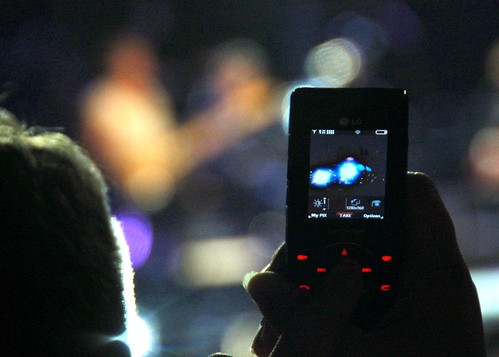
Cell Phones Everywhere
Cell Phones Everywhere by Scott Abelman

Peggy Orenstein in the Sunday Times Magazine ponders the emerging trend of sharing even our most mundane thoughts externally, in I Tweet, Therefore I Am..

On a recent lazy Saturday morning, my daughter and I lolled on a blanket in our front yard, snacking on apricots, listening to a download of E. B. White reading “The Trumpet of the Swan.” Her legs sprawled across mine; the grass tickled our ankles. It was the quintessential summer moment, and a year ago, I would have been fully present for it. But instead, a part of my consciousness had split off and was observing the scene from the outside: this was, I realized excitedly, the perfect opportunity for a tweet.

In describing this new desire, Orenstein raises the question that arises from this always-connected-real-time world: is this way of living better or worse than the way we used to craft our sense of self? Of happiness?

I asked the same question of myself last summer:

I worry a little bit when I go someplace new/interesting/beautiful that instead of experiencing it, I reach to my cameraphone. My modern technological instinct is that I won't get the gratification of going to this place *unless* I capture it in photograph and wait for the flickr/twitter/facebook comments to roll in.

Why can't I just inhabit the space in the moment?

Orenstein takes this to it's logical conclusion, but doesn't pretend that there's any turning back..

The expansion of our digital universe — Second Life, Facebook, MySpace, Twitter — has shifted not only how we spend our time but also how we construct identity. For her coming book, “Alone Together,” Sherry Turkle, a professor at M.I.T., interviewed more than 400 children and parents about their use of social media and cellphones. Among young people especially she found that the self was increasingly becoming externally manufactured rather than internally developed: a series of profiles to be sculptured and refined in response to public opinion. “On Twitter or Facebook you’re trying to express something real about who you are,” she explained. “But because you’re also creating something for others’ consumption, you find yourself imagining and playing to your audience more and more. So those moments in which you’re supposed to be showing your true self become a performance. Your psychology becomes a performance.”

The fun of Twitter and, I suspect, its draw for millions of people, is its infinite potential for connection, as well as its opportunity for self-expression. I enjoy those things myself. But when every thought is externalized, what becomes of insight? When we reflexively post each feeling, what becomes of reflection? When friends become fans, what happens to intimacy? The risk of the performance culture, of the packaged self, is that it erodes the very relationships it purports to create, and alienates us from our own humanity.

How do we re-take control of the personal reflective time we used to encounter on those quiet summer afternoons? Do we really need external forces to let us know that we're having a good (or bad) time?

For me, and from time to time, the best way to ensure this is by leaving my phone at home.

Sunday, June 20, 2010

Revisiting the World's Most Popular Camera

Which if you don't realize it, is a mobile phone-- never to be a single-use device every again.

One year ago, when I still parked myself at a desk at Flickr I wrote:
Mobile phones are certainly going to become the way most human beings capture and share images. The new iphone camera is good enough for most people to mean they don't have to buy a point and shoot camera. It's also going to negate the need for most people to have a video camera, as techcrunch reported this weekend. If you're a serious photographer or videographer, of course, you will have fancier equipment. But I'd propose that for most people, the newest mobile phones are more than good enough.

What does this mean? It means the people in the business of photos (camera manufacturers, printers, photo sharing web sites) had better have a story about how they make life easier for customers with mobile devices that take pictures and connect to the internet.
I heard from a few people who doubted this trend, and in particular doubted the footprint of the "iPhone." They were wrong.

Today, on the eve of the release of the iPhone 4 with an even better camera and video recorder, I am doubling down on this prediction (which by now is irrefutable) . What will this mean for the business of capturing, sharing and processing photos and video? Time will tell.


Thursday, June 03, 2010

Web Product Innovation in Emerging Markets

Gosh, Scribd has messed up the font formatting of this presentation. But either way, this is what Smitty and I presented at Echelon. It was super fun to present to the folks in Singapore!


Web Product Innovation in Emerging Markets

Monday, May 24, 2010

Yahoo! Acquires Koprol

Yahoo Acquires Koprol

Smitty and I have had the privilege of spending the last few months at Yahoo! working to jump-start the company's product line in emerging international markets. We've been particularly keen to find and build social media products that appeal to young internet citizens.

Koprol and their talented team in Jakarta Indonesia fit the bill. Here's what they say they want to do:

We want to help people to discover new and exciting people and places in the world

It is going to be fun to watch them make a go of this at even larger scale. The founders and the team (and the exploding Asian market) are have a great chance to go really big. Congratulations to the whole Koprol team!

(One can only hope that) Today's purchase purchase of Koprol is the first big step in a wave of new social innovation from Yahoo.

Tuesday, April 20, 2010

The Ascendancy of Facebook

Facebook gets crowned this week.

This week the six year old-Facebook will assert itself as a web powerhouse, alongside only Google with so central a place in the web ecosystem. They're announcing a slew of new features to the site and to the developer platform that assert their ambition. Don't misunderstand their ambition, says Om Malick,

To those who view it as the 21st century version of the online ghetto called AOL, you’re underestimating this gang. If Mark Zuckerberg and his troops execute on their plan, the web is going to be a lot different. I believe that Facebook will rival Google’s current domination of the search and online advertising business. These guys are ruthless, unrelenting and singleminded in their quest for success.

And it's true. Facebook has amassed a massive worldwide audience-- 400+ million-- who check in daily on their laptops and mobile phones to update a status, send a message, play a game, connect with a long-lost love or any of the other things that you see fleeting across your screen whenever you check in. And that's just the beginning.

Picture 1

So how is this possible? Isn't Facebook just an online photo album, a gathering place of teens? Well, no.

It's possible for three reasons...

It's got you. It has your time and attention, it's picking up on your habits and it wants to get more. It knows, for instance, who your friends are, where you went to school, what zip code you live in. And it also knows the type of movies and TV shows you like, and maybe even how you spend your money. At their developer conference this week Facebook will announce that they want to collect more data about where you are right now (think foursquare), and what you like on the web.

It's got any and all people who went your attention on the web. Ask any media website where traffic comes from, and they'll tell you that an increasing amount of it comes from Facebook (and twitter to a lesser extent). Five years ago the answer would have been Google search, by a longshot. The rise of "social media" lead by Facebook is changing the way people choose where to jump around the internet. More and more people are taking cues from their friends on Facebook. At their conference this week the company will announce new tools to integrate more of Facebook into sites all over the web-- through a new version of Facebook connect, a chat feature and an elegantly simple "like" button.

It's able to execute. Facebook has the best chance of anyone to pull these things together to dominate the next few years of the Internet, making lots of money through transactions, hyper-targeted advertising and who know what other means. Not only does Facebook have more of this incredibly valuable data than anyone else, they are set up to execute on this opportunity.

Is this good or bad? Probably a little of both.

Here's my scorecard, let me know if I'm missing anything:

  • The rise of a true competitor to Google on the web? Good.
  • The rise of an open platform that makes it easy to share what you want with people? Good.
  • The rise of a company that may stifle innovation, in it's desire to control more(most) of the social pipes connecting the web. Not so good.


---
Update: by posting this, I'm admitting that my boredom with Facebook from a few months ago, while honest, didn't represent a good read of the company's prospects. I was wrong.

Wednesday, April 14, 2010

Quora is made with awesomeness


This new site, founded my several notable former Facebook employees, is kicking butt even though it's open by invitation only.

Geoff Lewis wrote recently If You Work At A Startup But Aren’t On Quora, You’re Missing Out, and he's right (even though I don't work at a startup). His piece captures a bit of the great design, simple wisdom and small community-ness that makes this question and answer service so much more interesting than Yahoo! Answers, Hunch and Wikianswers.

There’s something about Quora. Its interface has just the right ratio of cleanliness to sexiness. Its seamless implementation of Facebook Connect login catches one’s mouse from across a crowded monitor. Its lithe speed makes the heart beat a little faster. But the quality of its questions and answers makes one fall in love. The rest of Silicon Valley seems to share my infatuation; after all, everyone is on it.


Quora today has a bit of the young, promising potential that I haven't felt on a web service since Foursquare a year ago. It's fun to visit, something that I can't say about many of the web services I visit each day.

More to come on this-- in the meantime, let me know if you need an invitation.

Wednesday, December 02, 2009

Peak Facebook

As in peak oil.


Hypothesis: Facebook is at it's peak, and can't go much farther into our online lives without completely overwhelming us with stuff. Hence, it's going to retreat-- at least a bit-- from the center of online social life for many.

So, when some guy named Jason Kincaid at Techcrunch says that Facebook is poised ot gobble up whole sectors of other interesting successful online social competitors, I say pffffft. (Watch Out Foursquare, Facebook is Poised To Dominate Geo).

Facebook currently is:

* a way to connect and communicate with old friends.
* a place to share stuff (namely photos) with said friends
* a way to promote yourself
* a place to waste time reading about your friends
* a place to play games/ take quizzes

Are you bored yet? What's the next big thing? Oh, I guess I'll just add another app to my iphone...

Page 2

This is not to say that Facebook is going to go away, or become marginal. It's just saying that facebook the company is doing a whole lot of things these days. It does some things very well. But we're full, and with each new thing Facebook becomes more of a messy portal.

We're ready for something new. And we've got so many choices.

Thursday, October 01, 2009

Web Headers: Balancing Customer and Business Interests

At big web companies, we call the top of the page the "header." The goal of the header is to:
  1. Tell customers where they are, and what product they're using
  2. Give them a common set of tools to help them find their way around your web site (usually a login/username link and maybe a help link and a search box to navigate the site).
  3. Promote other services that drive a company's business goals.


I'd like to call attention to two different companies and their approach to designing standard headers. It should tell us something about the companies and their focus and priorities.


Here's Yahoo! Groups, indicative of headers all over Yahoo.

Wasted Header Space
  • Yahoo! Groups logo
  • Account links
  • Help link
  • Promo for getting Yahoo! on your phone
  • Links to other popular Yahoo! products
  • Big search box for searching the whole web. (Not for searching Yahoo! groups)

Here's Google Reader, indicative of headers all over Google in non-search products.

Significantly More Relevant Use of Space
  • Link to a list of popular Google products
  • Google Reader logo
  • Account links
  • Link to settings

Which header does a better job of serving the customers of the product? How are the interests of the companies being expressed in these header designs? Which header has the right balance of these interests?

I would argue that Google's header is significantly more focused on the customer and the context. It's related to the Reader product with a search box for searching within reader. There are also a set of links promoting other products, but these don't get in the way. I wonder if Google had considered making the search box a web search box instead of focusing it on the Reader experience?

Yahoo's header is all about driving traffic to other Yahoo! services. In all the space they take up for the header, there is surprisingly little that's of use to me as a consumer of Yahoo! Groups. I wonder if Yahoo! header designers could pull the balance a bit further toward the group context without sacrificing the revenue and traffic driven by the other links?

Wednesday, September 23, 2009

Twitter Driving Flickr Galleries

When we built Flickr Galleries, one of things that we didn't have time to work on was discovery. How would people find a gallery once it was created.

Yesterday Tom Coates put together a Flickr Gallery of the dust storms in Australia and created a web sensation.

And he didn't need a Flickr discovery solution. He just used Twitter to get the word out. His gallery has 90K plus views in less than 24 hours. Wow.

Twitter as the Distribution Mechanism for Flickr

Tuesday, June 23, 2009

The World's Most Popular Camera

Is shortly going to be the a mobile phone (in this case, the Apple iPhone). I'd give it a matter of weeks until this happens. Follow this trend yourself in Flickr's Camera Finder.

Closing In


Partially, this is a quirk with the way apple classifies it's photo EXIF data. They roll up all of their mobile picture taking devices under one (first generation iphone, second generation 3G and even the new iphone 3gs). This means all these millions of cameras are contributing to this trend as opposed to major camera manufacturers and cell phone makers, who break out each device separately. So partially this is a bookkeeping trick.

But more significantly, mobile phones are certainly going to become the way most human beings capture and share images. The new iphone camera is good enough for most people to mean they don't have to buy a point and shoot camera. It's also going to negate the need for most people to have a video camera, as techcrunch reported this weekend. If you're a serious photographer or videographer, of course, you will have fancier equipment. But I'd propose that for most peope, the newest mobile phones are more than good enough.

What does this mean? It means the people in the business of photos (camera manufacturers, printers, photo sharing web sites) had better have a story about how they make life easier for customers with mobile devices that take pictures and connect to the internet.

Tuesday, May 26, 2009

What Is Yahoo!? - A Call To Arms


This legitimate question has been kicking around the worlds of technology and media for about 10 years. Kara Swisher asked it again, with some resonance, in preparation for today's talk with new Yahoo! CEO Carol Bartz at the All things D conference.

After all, in 2009, it is still hard to answer the simple question: What is Yahoo?

That’s the one that stumped former Yahoo CEO Jerry Yang onstage at our sixth D: All Things Digital conference last year.

And, it will still be the key query that Yahoo CEO Carol Bartz will need to answer when she takes the stage Wednesday morning at D7.

I have been noodling all weekend about what to ask the forthright executive, who does not seem to mince words or suffer fools.

That’s good, since it will take that kind of gumption to clearly lay out for the influential crowds of attendees and assembled tech press exactly what she is going to do now that she has started to make the basic structural changes at Yahoo.

I can't wait to hear Bartz's answer. (update: her answers are posted here)

Not knowing the company's core focus means that projects get approved, but underfunded. It means that what was important last year is no longer strategic this year. Witness the departure yesterday of the talented Satish Menon and the write off of Maven Networks, a video platform company that Yahoo bought last year for $160 Million. Um, yeah, I just said what was $160 Million important to Yahoo last year is no longer important today.

The highest levels of Yahoo! MUST have a clear and compelling vision for what products it wants to make better than anyone else.

Founded as a web directory , Yahoo started by offering people easy to navigate links to the relatively small universe of web sites back in the day. Then it branched into Mail (with the acquisition of four11, the genesis of Yahoo Mail), Media (think Yahoo! News, Sports and Finance) and Community (eGroups, the genesis of Yahoo! Groups).

Terry Semel came aboard as the CEO in 2001 and brought professional culture to management sales forces, and was handsomely rewarded when the online economy rebounded.

Recovering from the dot com bust and recognizing the threat of Google to the business, Yahoo! bought into search via Overture and Inktomi (in 2002-2003). Between 2004, the company bought into some other relatively small businesses, including Flickr.

The company has grown through acquisition and a "fast follow" strategy, recognizing emerging trends and buying and occasionally building in to new web businesses. Yahoo! has never been a strong incubator of unique ideas, but has excelled at scaling businesses BIG and globally, and monetizing them.

So, what you have is arguably a business built by acquisition into the following grouping of core services the company offers customers:

Search
There are 2 fundamental questions that Yahoo! must answer here. First, how to compete with Google. Is it by copying Google features (arguably, the strategy for Yahoo! from 2004-present), by differentiating itself with features, or by offering customers a completely different experience than Google, essentially finding a way to turn search on its head.

The second question is whether to sell this business or not. This has already been endlessly speculated upon, and I have no great insight to add to the debate.


Communications
By communication, I mean Yahoo! Mail, Yahoo! Messenger, Yahoo! Groups-- all number one in their product categories globally. (Flickr is here too, but I won't speculate on it because I work there).

Arguably, many of these products have stagnated in the last several years, and have lost focus. And more than other Yahoo! businesses, these are the most threatened by the rise of completely new ways of communication like Facebook and Twitter.

I think Yahoo! should pursue 2 tracks in parallel for these business. First, they must develop a clear product differentiation strategy for Mail, Messenger and Groups. These are diamonds in the rough, lack a clear purpose (nee value proposition), and deserve to be restored to their rightful place as best in class web and mobile products, which they currently aren't.

Secondly, I think Yahoo! must find and acquire some small social products that it can stitch together as an alternative social network or sorts. Yahoo! can't afford Facebook or Twitter, but it may not need these. If Yahoo! can find a emerging social tool and then scale it (via Yahoo! mail, et al), it can effectively create a new facebook-scale social tool. It needs to be an acquisition, because up until now Yahoo's internal social network building has been lackluster.

Media
Meaning Yahoo! News, Sports, Finance, Entertainment, Shine, OMG, blah blah blah. These media properties are strong in the US, and have less-dominant roles in most other markets around the world. These are core to Yahoo! and what it is to customers, but just like the communication products their focus and quality have a mixed record in recent years.

Historically, these have been sites that package up content from other sources with some original reporting and data services (Finance, in particular, has carved out a really uniquie position offering best in class original content, tools and data).

What sort of content will Yahoo package in those sites? Will it be licensed content, like Reuters, AP, etc) or will it be originally reported, as AOL seems to be pursuing. Or will it be user generated? Or will it be all 3, as Yahoo's female-oriented shine has had some success packaging together?
And, what media properties does Yahoo! want to offer? Currently, there is a long list of thinly spread media sites that the company offers.


Everything Else
Here's a long list of everything Yahoo! offers, if you're interested. These maybe should, or maybe shouldn't be divested. But I can't see how they're core to the future of the company.

---


(this post reflects my personal views as a shareholder. It does not represent any informed position as a Yahoo! employee)

Saturday, February 07, 2009

Online Media, After the Shakeout

I've started to make a list in my head of the American media outlets that interest me, that will have relevance and resonance after the shakeout that I think will probably come from a prolonged recession. So the premise here is that we are having a deep recession, and that not all media companies are going to come out strong and relevant.

This list is not exhaustive, and to illustrate this let's leave Yahoo! and Flickr (my truly humble employers) out.

This is a working list, in no particular order full of bias based on what interests me. And it's full of jargon because I frankly can't help it.

1. The New York Times. Not the biggest, but among the best. Hopefully the terrible year that just ended for the New York Times Company will lead to a new period of innovation around how to make money from their readers.

2. Gawker Media, editorially driven blog networks et al. This is not user generated content, but content edited by people who know how to write about interesting things. When well run, I think low cost high quality scalable editorial media will thrive.

3. Facebook. Say what you want about their user experience or their photo sharing wishy-washiness, they matter because they've managed to tap into the fact that people care about what their friends are saying, doing and reading on the web.

4. Twitter. Not a perfect product, in fact a little bit abstract for some people, but one that seems to scale to allow people to do lots of things. Besides the fact that it's being used by an increasing number of celebrities and digerati, I think some big shots see this as possibly a cleaner, nicer, more scaleable version of the next big thing, where facebook is now is in the mainstream mind.

5. Google. I keep forgetting them, but they're strongly positioned to do more cool things, though perhaps none of them ever as big as what they've done in search.

6. NBC Universal. These folks aren't dummies, and in spite of the financial market explosion I think they're still going to be well-funded by their owners at General Electric. Even though the local advertising market has apparently exploded in the last 6 months, look at how they're reinventing their owned and operated local stations.

7. News Corp. Say what you want about Rupert Murdoch and Myspace (irrelevant), but if his children can pick up where he leaves off this media conglomerate should try and double down in the online world with force.

8. Some magazine publishers. I'm hesitant to put Conde Nast, Time inc, Hearst or anyone else up here because they're struggling online so. But some of them will figure out an approach to the web.

Who else? And who new is emerging?


---

The less relevant:

* Microsoft. I continue to be baffled about what Microsoft is trying to do on the web.
* Newspaper companies without deep national brands (Hearst, McClatchy, Gannett, etc)
* Ebay. Not really media, but deserving of being on any list of irrelevance.
* Viacom. Kind of lost, made rudderless by Sumner Redstone's ego.
* CBS. Also a Redstone play. They bought CNET but I still think they're unlikely players.

Tuesday, November 20, 2007

Flickr Goes Places


Flickr launched a long-anticipated new feature called Places today. It's a neat way to hop around the world and see the most interesting photos associated with a place. It a big leap forward from their first effort at overlaying photos on a map. Here's wired's take.

Congratulations to the Flickr team, who obviously have a lot to say about how photos should get explored and discovered once they're uploaded. Those guys get to work on such interesting stuff!

Thursday, November 08, 2007

Old Media to New: How NPR Gets the Web


I need to get some work done this morning, so I'll just jot a quick thought down here and then come back and expand.

NPR understands the web, and is moving aggressively to expand their product offerings to take advantage of the web. They appear to recognize their strengths (storytelling, audio, music) and have moved to expand on this and on the way people get this information (radio, podcasts, online, etc.)

Nothing illustrates this better than the way they handled the re-launch of their NPR Music website. I heard about this launch:
* Through announcements on their radio programs
* Through chatter on some music blogs I read (pitchfork, notably)
* Through a program note on a podcast I subscribe to.

Check out their music site (which I find way too busy and somewhat confusingly designed). The content is top notch. Here's a richly produced, really interesting video production tracking the songwriter Stephin Meritt writing a song over 2 days.

NPR gets the web!

Thursday, November 01, 2007

Web-Delivered Applications

The last couple of days have been interesting for those of us who work in technology, and subscribe to a whole boatload of tech news feeds. The news:

* Microsoft takes a stake in Facebook, which thinks it's worth $15B

* Google is super valuable... 1 share = $700

* Google announces OpenSocial, to open up the social network development platform.

Why, you might ask, does this matter? Because many in the computing business think that boxes labeled "Windows Vista" and "Adobe Photoshop" are a thing of the past. You won't need Windows (or OSX) to get to the web, and almost all the applications you currently use (Mail, photos, movies, word processing, etc) are going to live on the web. And a lot of these are going to be supported by advertising closely targeted to you.

Facebooks developer platform-- while filled mostly with crap-- has shown that this web-delivered application world is closer at hand, perhaps. Who's going to own that world? Microsoft (probably not), Google (very likely), Facebook (perhaps, they certainly think so) or someone else? The big shots of the tech world are getting in now, and they're making some bets.

p.s. --I have to ask this question because of my old loyalties: Where is Yahoo!? What do those 6 hour long executive meetings sound like in Sunnyvale? Show us something, my people!

Wednesday, October 31, 2007

Social Media Ingredients

Here are some of the building blocks to think about if you're looking to build and maintain a relevant media service on the web these days:


1. Be the hub. Make your customers feel vested in keeping their content with you. That's the real value exchange. Make sure you can accept all the different types of media they want to share.

2. Be open. Widgets, openid and the social graph factor in here.

3. Make the product accessible. Even with the success of youtube, flickr and Apple, online multimedia still intimidates. It needs to be wickedly accessible to nonsophisticated users all over the world. Take down the old barriers.

4. Think about Consumers and Producers. While it's critical to get people to upload content (the producers), it's equally important to focus on how people find cool stuff (the consumers). Discovery in social media is so much more than search: it's slideshows, maps, friend summaries and all sorts of other interfaces as-yet-undefined.

5. Be really mobile. How are people using social media (photos, videos, short text updates like twitter) when they're out an about with their increasingly powerful mobile phones.

6. Be distributed. Content being generated by your customers needs to be able to be distributed wherever they are. Be incredibly progressive about this.

last, but not least....

7. Be entertaining. I see a lot of folks that miss this one.